At the Jazz Band Ball by Hentoff Nat
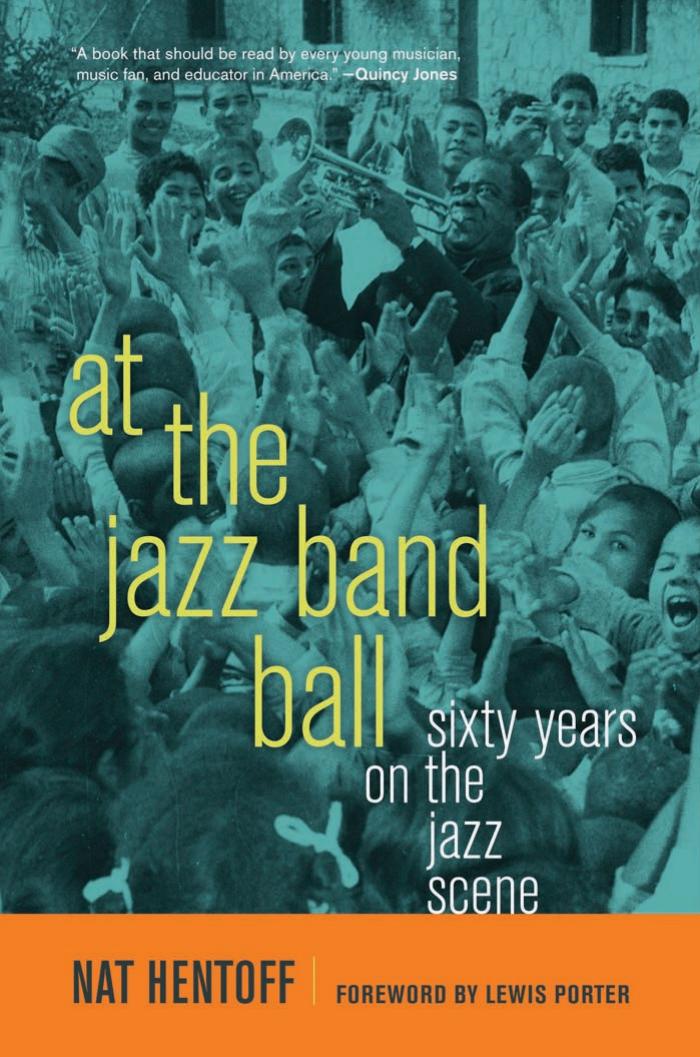
Author:Hentoff, Nat [Hentoff, Nat]
Language: eng
Format: epub, pdf
ISBN: 978-0-520-26113-6
Publisher: University of California Press
Published: 2010-04-09T04:00:00+00:00
40 | Quincy Jones—Past, Present and Future
When I left Boston in 1953 to become New York editor of Down Beat, the first musician I came to know well was Quincy Jones. He was twenty and already writing crisply uncluttered arrangements for a variety of jazz record dates, and soon was contributing some of them to Count Basie, who had no patience for excess notes.
Quincy was so guileless that at first he appeared naive; but as he became a key part of the jazz scene, it became clear that he was interested in, and quickly knowledgeable about, all of music, and uninterested in the stiff categories set up by critics and even some musicians.
By 1956, he had been musical director for Dizzy Gillespie’s big band, and the next year, he studied with Nadia Boulanger in Paris. In the early 1960s, Quincy was conductor and arranger for Frank Sinatra, who nicknamed him Q, which his closest friends—who seem to be in the hundreds—have since called him.
Continually challenging himself, Quincy wanted to write for films, and as he learned the craft, his scores included In the Heat of the Night and In Cold Blood (which won him an Oscar in 1967). He was also in the recording studios, not only as a leader-arranger but also as a producer at Mercury Records in 1961. Three years later, he became a vice president of the label, the first black person to head a jazz division of a major record company.
Widely traveled, Quincy did more than absorb the music of various countries. He saw how music was able to ease tensions among people of otherwise different cultures, and he began to figure out how to use music to make a difference in the lives of children in grave need. In 1985, he produced and conducted a recording, We Are the World, with international artists across the musical spectrum, that raised $60 million to deal with famine in Africa.
Wherever Q went, he created ways to change the attitudes and lives of kids. Once, in New Orleans, he persuaded a television station—as Scott Smith reported in Hemisphere Magazine—to run frequent stories about a different student who had achieved A’s. He wanted, he said, “to redefine in that community what it meant to be cool.”
In 1991, he told me he had founded the Listen Up Foundation to get youngsters involved in other people’s problems. One program, From South Central to South Africa, involved bringing Los Angeles inner-city kids at risk of being recruited by gangs to South Africa, where five of them helped Habitat for Humanity build homes for poor citizens. Since then, Listen Up has given $400,000 to build homes for the homeless in South African townships.
In recent years, Quincy has been working on his most ambitious project, We Are the Future, to provide training and health services to “children who struggle in the face of hunger, violence and disease” (wearethefuture.com).
Among his partners in this insistent expansion of the Listen Up Foundation are the World Bank and its
Download
This site does not store any files on its server. We only index and link to content provided by other sites. Please contact the content providers to delete copyright contents if any and email us, we'll remove relevant links or contents immediately.
The Goal (Off-Campus #4) by Elle Kennedy(13777)
Kathy Andrews Collection by Kathy Andrews(11966)
Diary of a Player by Brad Paisley(7647)
Assassin’s Fate by Robin Hobb(6292)
What Does This Button Do? by Bruce Dickinson(6259)
Big Little Lies by Liane Moriarty(5876)
Altered Sensations by David Pantalony(5155)
Pale Blue Dot by Carl Sagan(5077)
Sticky Fingers by Joe Hagan(4253)
The Death of the Heart by Elizabeth Bowen(3675)
The Heroin Diaries by Nikki Sixx(3609)
Confessions of a Video Vixen by Karrine Steffans(3351)
Beneath These Shadows by Meghan March(3341)
How Music Works by David Byrne(3327)
Computational Linguistics and Intelligent Text Processing: 20th International Conference, CICLing 2019 La Rochelle, France, April 7â13, 2019 Revised Selected Papers, Part I by Alexander Gelbukh(3244)
The Help by Kathryn Stockett(3188)
Jam by Jam (epub)(3147)
Harry Potter 4 - Harry Potter and The Goblet of Fire by J.K.Rowling(3130)
Strange Fascination: David Bowie: The Definitive Story by David Buckley(2910)
